
EU Regulators Back Daraxonrasib, the Pill That Nearly Doubled Survival in Advanced Pancreatic Cancer
Europe's medicines committee recommends the first-in-class RAS inhibitor seven weeks after FDA approval. The phase 3 data are striking, with caveats.
By Katie Coffee
For patients whose metastatic pancreatic cancer progresses after first treatment, the standard next step has been more chemotherapy [5]. A pill approved in the United States in August is now on track for Europe. On October 16, the European Medicines Agency's human medicines committee (CHMP) published its recommendation that daraxonrasib, sold as Rasonque by Revolution Medicines, be authorized for adults with metastatic pancreatic adenocarcinoma who have already received at least one prior treatment [1]. The company announced the positive opinion a day earlier [2].
Background
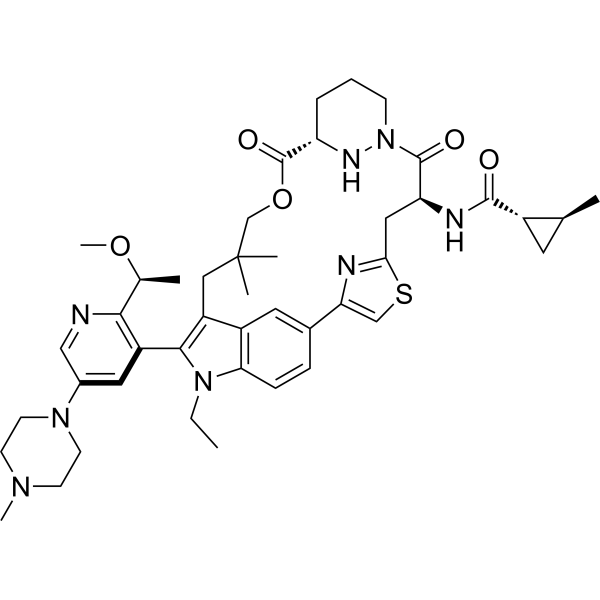
Daraxonrasib is an oral drug that targets RAS signaling proteins. Rather than hitting one mutation, it is designed to block the active, GTP-bound form of both mutant and normal RAS [5]. Dana-Farber describes it as a "molecular glue" that partners with a cellular protein, cyclophilin A, to shut down RAS signaling [6]. In this case, getting stuck is the whole point.
The FDA approved the drug on August 26, 2026, for adults with metastatic pancreatic adenocarcinoma who have received at least one prior systemic therapy or who are not candidates for multiagent therapy [3]. The agency called it a first-in-class targeted therapy and reviewed it under the Commissioner's National Priority Voucher pilot program, alongside Breakthrough Therapy, Orphan Drug and Priority Review designations [3]. The EMA, for its part, had flagged the medicine as a high priority under its Cancer Medicines Pathfinder because of the unmet need in this disease [1].
What Was Found
Both regulators relied on RASolute 302, a global, randomized, open-label phase 3 trial in 500 adults with previously treated metastatic pancreatic adenocarcinoma [2,3]. Patients received either daraxonrasib or the investigator's choice of chemotherapy; the most common regimens were gemcitabine plus nab-paclitaxel and liposomal irinotecan plus 5-fluorouracil and leucovorin [5]. The primary analysis was presented at the 2026 ASCO Annual Meeting and published simultaneously in the New England Journal of Medicine [2,4].
In the overall study population, median overall survival was 13.2 months with daraxonrasib versus 6.7 months with chemotherapy, a hazard ratio for death of 0.40 (95% CI, 0.30 to 0.53; P<0.0001) [2,3]. Median progression-free survival was 7.2 versus 3.6 months (HR, 0.49; 95% CI, 0.38 to 0.64) [2]. The confirmed objective response rate was 31.6% versus 11.2% [6].
Patients on the drug also took longer to report worsening pain: a median of 9.2 months, compared with 3.8 months on chemotherapy [5]. At ASCO, discussant Dr. Knox put the survival curves in context: "I don't think this has ever been seen in pancreatic cancer" [5].
Study Design and Limitations
The drug was not free of toxicity. Grade 3 or higher treatment-related adverse events occurred in 43.6% of patients on daraxonrasib and 57.5% of those on chemotherapy, and treatment-related discontinuations were 1.2% versus 11.2% [5]. In the European summary, the most common adverse reactions were diarrhea (63.1%), acneiform dermatitis (62.4%), stomatitis (55.5%), nausea (50.8%), vomiting (41.6%) and fatigue (33.2%) [2]. Warnings listed by the company include dermatologic toxicity, stomatitis, diarrhea, gastrointestinal perforation, interstitial lung disease or pneumonitis, and embryo-fetal toxicity [2].
Several caveats apply. The trial was open-label, so patients and clinicians knew which treatment was given, which can influence subjective outcomes such as pain and quality of life [3]. Median follow-up at the ASCO presentation was 8.5 months, so long-term survival remains unknown [5]. The study tested the drug after first-line treatment, a point the ASCO discussant raised as a limitation of the design [5]. The trial was funded by Revolution Medicines [5,6].
Clinical and Patient Implications
In a setting where the chemotherapy arm's median survival was 6.7 months, a median gain of about six and a half months is a substantial difference [2,3]. The EU wording differs slightly from the US label: the recommended European indication covers adults who have received at least one prior systemic therapy, while the US label also includes patients who are not candidates for multiagent therapy [2,3].
The recommendation does not yet allow prescribing in the EU. Revolution Medicines notes that a European Commission authorization would not apply in the United Kingdom or Switzerland [2]. Rash and stomatitis call for supportive care, and the discussant noted that managing them takes clinical resources [5].
What Comes Next
The CHMP opinion now goes to the European Commission for a final decision; the company has not given a date [2]. Open questions include durability of benefit with longer follow-up and whether the drug helps earlier in the disease, which RASolute 302 was not designed to answer [5]. By regulatory standards, the file has moved briskly: from US approval to a European recommendation in about seven weeks [2,3].
This article is for informational purposes only and is not medical advice. Readers should consult their clinician about any treatment decisions.
References
European Medicines Agency. Meeting highlights from the Committee for Medicinal Products for Human Use (CHMP) 12–15 October 2026. EMA. October 16, 2026. https://www.ema.europa.eu/en/news/meeting-highlights-committee-medicinal-products-human-use-chmp-12-15-october-2026
Revolution Medicines. RASONQUE (daraxonrasib) Receives Positive CHMP Opinion Recommending Marketing Authorization in European Union for Metastatic Pancreatic Cancer. Press release. October 15, 2026. https://ir.revmed.com/news-releases/news-release-details/revolution-medicines-rasonquetm-daraxonrasib-receives-positive
U.S. Food and Drug Administration. FDA Approves First in Class Targeted Therapy for Metastatic Pancreatic Cancer. FDA press announcement. August 26, 2026. https://www.fda.gov/news-events/press-announcements/fda-approves-first-class-targeted-therapy-metastatic-pancreatic-cancer
O'Reilly EM, Wainberg ZA, Hendifar AE, et al; RASolute 302 Trial Investigators. Daraxonrasib or Chemotherapy in Previously Treated Metastatic Pancreatic Cancer. New England Journal of Medicine. 2026;395(4):325-337. Published online May 31, 2026. doi:10.1056/NEJMoa2605555. https://www.nejm.org/doi/full/10.1056/NEJMoa2605555
Helwick C. Daraxonrasib Nearly Doubles Survival in Previously Treated Metastatic Pancreatic Cancer. The ASCO Post. June 10, 2026. https://ascopost.com/issues/june-10-2026/daraxonrasib-nearly-doubles-survival-in-previously-treated-metastatic-pancreatic-cancer/
Dana-Farber Cancer Institute. RAS(ON) Inhibitor Doubles Median Overall Survival in Results of Phase 3 Trial for Patients with Metastatic Pancreatic Cancer. News release. May 31, 2026. https://www.dana-farber.org/newsroom/news-releases/2026/rason-inhibitor-doubles-median-overall-survival-in-results-of-phase-3-trial-for-patients-with-metastatic-pancreatic-cancer
